A Database Management System (DBMS) is a software application that allows users to manage and organize data efficiently. A DBMS is structured with a query processor and a storage manager that sit between users/applications and disk storage.
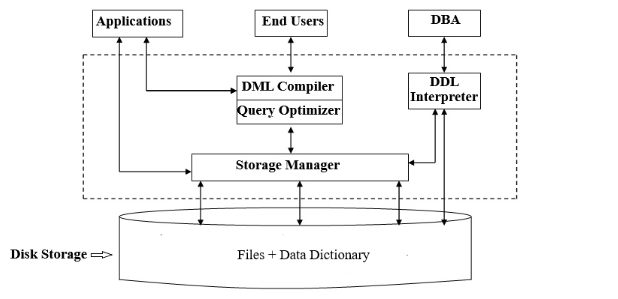
The query processor translates and optimizes user queries, while the storage manager handles the physical storage, including managing files, transactions, and a buffer for frequently accessed data. Disk storage holds the actual data, index information, and the data dictionary.
Query Processor
- DDL Interpreter: Interprets and processes Data Definition Language (DDL) commands (like
CREATE TABLE) to update the data dictionary. - DML Compiler: Compiles Data Manipulation Language (DML) commands into low-level file access commands.
- Query Evaluation Engine: Carries out the optimized queries to retrieve data.
- Authorization and Integrity Managers: Ensure users have the correct permissions and that data integrity constraints are maintained.
Storage Manager
- File Manager: Manages the allocation of space on disk storage and the data structures used to represent data.
- Buffer Manager: Manages the transfer of data between main memory (RAM) and disk. It keeps frequently used data in memory to speed up access and reduce disk I/O.
- Transaction Manager: Ensures that database transactions are processed correctly, maintaining consistency and durability, and handling potential failures.
Disk Storage
- Data Files: Contain the actual database records and are stored physically on devices like hard drives or SSDs.
- Data Dictionary: A system catalog that stores metadata, which is “data about data” (e.g., table names, column types, relationships, constraints).
- Index Files: Used to improve the speed of data retrieval operations.
There are four types of DBMS, these are:
- Relational DBMS (RDBMS),
- Hierarchical DBMS,
- Network DBMS &
- Object-Oriented DBMS (OODBMS)